
Doreen Ríos (2/2): Ambiguities, Piracy, and Xatarrera Communities—«Symbolically dismantling the monopolistic empires of technology.»


Cover: Portrait of Doreen Ríos / Photo: Fernanda de Terreros.
Interview: Nicolás Kisic Aguirre / Edited by: Yeudiel Infante & Nicolás Kisic Aguirre
This is the second and final part of the conversation I had with Doreen Ríos via Zoom in May 2024. In the first part, we discussed technical, tactical, and technological forms of disobedience: collective imaginaries, the “second life” of technical objects as conceived by Simondon, and why the European concept of tactical media falls short when it comes to understanding what is happening in Latin America.
In this second part, the conversation turns to ambiguity, piracy, and technological reappropriation as everyday practices in Latin America. From the Plaza de la Tecnología to the xatarrera communities, via Afro-Peruvian cajón music and the figure of Caliban, Doreen Ríos reflects on alternative ways of creating, sharing, and thinking about technology, challenging notions of ownership, authorship, and hegemonic models of innovation.
As in the first part, many of the ideas presented here are explored in greater depth in Medios inestables. De objetos técnicos y arte (A Coruña: Bartlebooth, 2025), Doreen’s recently published book.
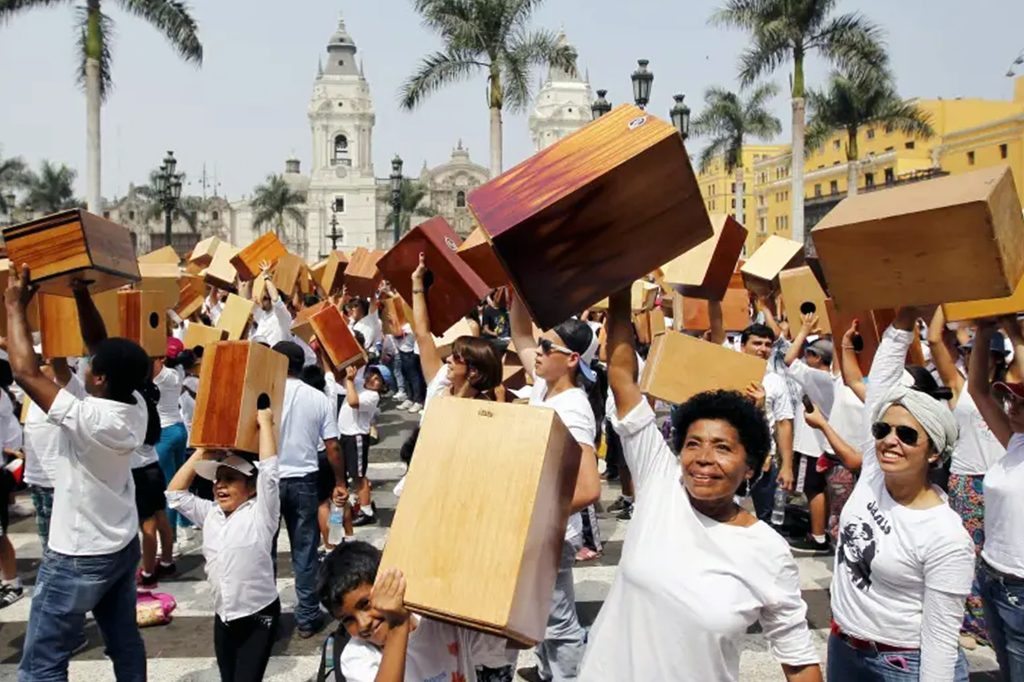
Nicolás Kisic Aguirre: We don’t have the utopia of “freedom” so firmly secured. [In Latin America] anything can happen at any moment, things can always get worse. We don’t have that foundation to sustain us. The idea of ambiguity comes to mind. I feel that in Latin America, ambiguity is sometimes… I’m not sure if it’s a tactic, but it is certainly a way to do something without actually doing it. I’m thinking of a musical instrument that I find very interesting: the Afro-Peruvian cajón1. It is a wooden box. A box that [presumably] was used to store fruit in the countryside, and that the enslaved population began to use as a drum following a [vice-royal] ban on the use of drums. The drum, then, is not only a drum but also a means of communication, of expression, of thousands of other things… Suddenly, the answer is a wooden box that functions as a drum when no one is looking, and when they are looking, it’s nothing more than a wooden box. So it carries a very powerful ambiguity. It’s the object’s lack of definition. It’s like: what is this? It depends, doesn’t it? It depends on who’s asking.
Doreen Ríos: It is everything and it is nothing. That’s where there’s no room for that dialectic that’s so deeply ingrained in Western logic. Because it is an ambiguity, but it’s also improvisation.
NKA: Right, maybe a reaction…
DR: There’s an innate ability to know how to react to change. I don’t know if it’s good or bad, but at the end of the day, to oversimplify and generalize a lot, the ability to respond when living in Latin America is based on the fact that things could be radically different tomorrow. We know this, and we live with that lack of stability. And, obviously, something has to give you a sense of security. The only thing that gives us security is knowing that we can react to change, the ability to face that change.
Last week I attended a seminar in Salzburg, and many people were saying, “But what are we supposed to do? How can we possibly go against those hegemonic forces when it’s already so hard to live without social media?” For reasons, I don’t know, related to work and such. We’d have to reinvent the wheel, they said. Well, in Mexico there are communities, mainly indigenous ones, that have their own telecommunications systems built from scratch2. Don’t tell me it can’t be done. Of course it can. The thing is, [Europeans] aren’t seeing it because there are still those limitations, that everything has to be absolutely defined, direct, and reveal its single, exclusive intention. And that doesn’t help us think about what we’ll do when this changes. Well, when this changes, we’ll use it differently. We won’t get rid of it, but rather transform it into something else. And yes, I do believe it’s an absolutely and profoundly cultural issue.
My thesis advisor tells me that, for her (she’s an expert in visual culture and indigenous studies), at the end of the day, it’s the mestizo act of “I can use it for what it is, but I can also imbue it with this second, third, or fourth kind of life.” As you were saying [about the Peruvian cajón], this is a box that holds fruit, or it’s a musical instrument, or it’s a weapon… and it’s something that, when you try to fit it into a very specific dialectical logic of what it is and what it isn’t… what it is and what surrounds it, what it is versus the rest… it’s something that will change depending on the context in which it’s being used. It’s not something about which you can say, “This is what it will always be, and this is fixed and stable.” And if that doesn’t hold true for an object that’s actually designed for a single function, just imagine, for an object designed for multiple functions, well, that’s just crazy.
NKA: Yes, I was thinking about the phone. The interesting thing is that it’s still called a “phone.” And the part of the device that’s used the least is the phone itself. I could call it a flashlight, and that would be more accurate. It’s almost a linguistic situation. It’s hard to escape the definition, isn’t it? And we have to keep calling them phones even though they’re used a thousand times more as cameras, but you’re not going to say to anyone, “Pass me my flashlight.”
DR: My flashlight-calculator-camera!
NKA: Suddenly, we don’t have the words. What do we call it? How do we create that ambiguity through communication? We fall into the “trap,” in a way. I don’t know if we need that trap to maintain a certain level of sanity. Because otherwise, what do we do? How do we communicate?
DR: What you say about the trap of language is also tough. When I share my research, it’s very common for the first thing people say to me to be: “This is too much,” “It’s overwhelming,” “What are we supposed to do with all of this?” It overwhelms you and gets out of hand. What do you do with that? How do you stay sane throughout that process, too? We were just coming back to Audre Lorde’s famous line: “The master’s tools will not dismantle the master’s house.”3, and I would say: If you use them for what they were designed for, no, definitely not… But if you use them in a different way, I think so.
NKA: Yes, you could say that the master’s tools will bring down the master’s house.
DR: Sure, because I’m going to use them for something different. And I think that here, in the United States, I’ve realized that this is perceived as something incredibly radical. I don’t know if it’s because it’s California and, after all, Silicon Valley is right up here. I don’t know if it’s, again, a cultural thing, because there’s something very stifling and paralyzing about being so categorical when saying whether something is possible or not. If you’re doing this, then it can only be done this way. I don’t think it’s that simple. Because I’ve seen this emerge in other ways. Maybe, if I’d never seen this in practice, I might also tell you: well, I don’t think it’s possible. And that’s what sometimes strikes me as very peculiar. It’s been really hard for me here in general. Not with my thesis advisor, though, because she’s Mexican. She gets it, and I don’t have to explain it to her. But with the rest, I struggle. The idea of technological disobedience is hard for them to grasp; it sounds like something that shouldn’t happen, you know? It’s like there’s this aspect of the idea of disobedience that’s like: “Why would you do that? That’s wrong.”
NKA: I was going to tell you something I thought was interesting. You mentioned it when you talked about the Plaza de la Tecnología (Technology Plaza) in Mexico.
DR: I love the Plaza de la Tecnología!
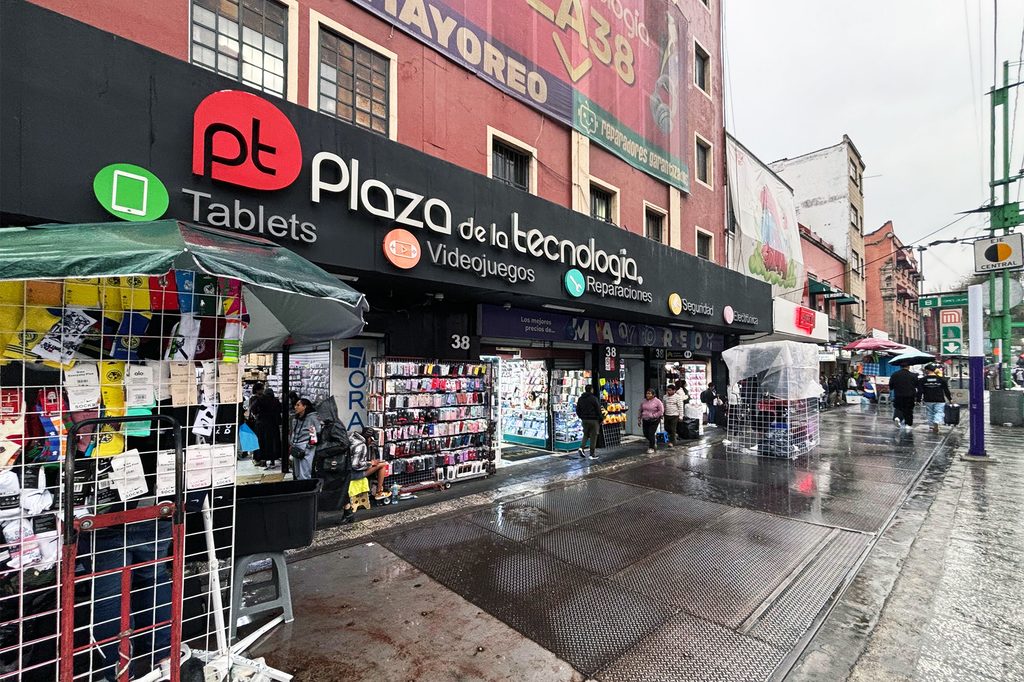
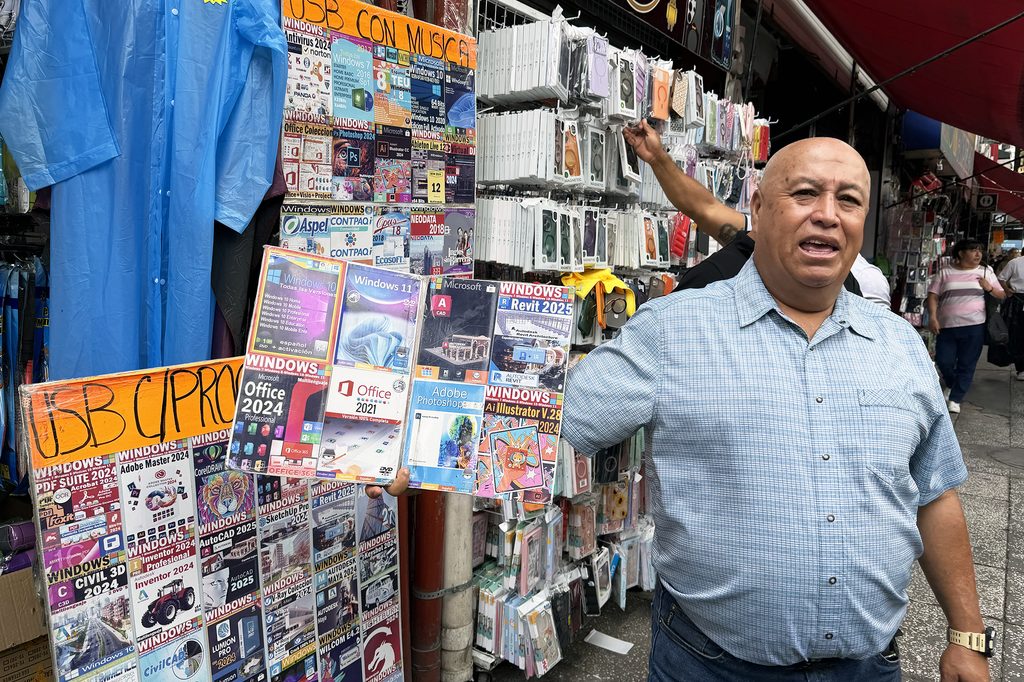
NKA: It’s the same in Peru, exactly. There are Polvos Azules, Polvos Rosados, Wilson, Paruro… There are several places where you can buy the software you want. As a kid, I used to buy the music I wanted. Now that you were talking about your experience in Salzburg, I’m thinking about how there’s a trend that’s also [very] valuable; it shouldn’t be underestimated, but there’s always been a trend in Europe that goes: “Let’s use free software, do everything from a free-software perspective, and free ourselves from the big corporations.” Whereas in Mexico, you say, “Well, I’m interested in that,” so I just go ahead and pirate it. Any software I want, I’m going to use it however I want.
DR: Yes, yes. [In the United States] that’s a very radical idea!
NKA: [Of course,] in the United States, or in the North in general, piracy is a very serious offense, isn’t it?
DR: That seems really crazy to me, because here they used to tell us, “They’re not going to let us fix our devices anymore.” Because, you see, Apple had it strictly forbidden; if yours broke or something, you had to take it to the Apple Store. And I’d say… I’m not going to ask them for permission! I find it really funny, actually. But I think Ernesto Oroza covers it really well in the short piece on his website about technological disobedience4, where it says that [technological disobedience] also goes against the identity of the product and its brand. It’s not just about fixing the object; it’s about rebelling completely against what an iconic brand like Apple, Microsoft, Autodesk, Adobe, or any other represents. And that’s a much bigger deal here than in Latin America. Of course! When I started architecture school, the very first thing I ever did, since I’d never owned a laptop before, was go to the Plaza de la Tecnología and ask them: “I have this much money; I need a computer for these things.” I remember perfectly well that they even installed the software for me. I mean, I remember they offering, “this is on the house.” What do you need? AutoCAD? There it is. Photoshop? There it is. Illustrator? There it is. And that computer has been with me for ages and still works. It’s ridiculous, isn’t it? In my mind, it’s even counterintuitive to want to buy a new device when you can have one that, on top of everything else, I find very sophisticated in the sense that it’s customized. It’s exactly what I need, no more, no less. It’s made for me. And, above all, here [in the United States], where there’s now this trend toward hyper-personalization of all devices, and, really, of everything. Putting your name on it, changing the color, and adding a little design…
NKA: Perhaps [that trend] is an example of how a strategy becomes hegemonic. Isn’t it?
DR: Yes! It seems totally out of sync to me, weird, I don’t know. There’s an issue and a conversation that, at their core, have to do with [financial] accessibility, of course. At least in Mexico, that’s how it is. You walk up to the booth at the Plaza de la Tecnología and say, “I have this much money, what can I get with it?” It’s not “I can’t buy it because I don’t have the money to buy it new.” And there’s a negotiation involved, too. To me, that’s a crystal-clear example; it’s not the same technical object as when someone tells me, “I work with the newest computer I bought directly from the Apple Store.” I mean, excuse me, but no… because even if it’s exactly the same in its abstract form, so to speak, the software that this other person is using on the other side, its concrete form is a personalized object; it’s an object made from parts of other objects. And although it’s not part of their discourse, because, of course, the people at Plaza de la Tecnología are the last ones interested in coming to talk about climate change, at the end of the day, it’s a far more sustainable object than any of those other objects that weren’t created in the same way.
NKA: Of course!
DR: And that should matter when we talk about what happens to those objects afterward. Of course it matters. Like you said, free software: there’s a big free software movement in Mexico. But it’s a big free software movement more because of the ability to tweak and modify the software’s functions, which could just as easily be done with something that’s exclusively open source, right? Like, “Well, I want to add this new feature.” It has more to do with that ability to alter things than with [financial] accessibility, because when it comes to accessibility, I go to my neighbor, the hacker, and I swear he’ll set up any software I want. And I buy him two beers, and we’re all set!

People here were asking me: Why don’t you replace “technological disobedience” with “technological resilience”? Well, no, because resilience implies an act that, to me, infantilizes and oversimplifies what’s actually happening there. Because that narrative of “oh, look, in Latin America we don’t have access, so we have to create”… Look, that’s part of the story, but it’s not the whole story. There’s another side to it that has to do with consciously choosing not to do it the traditional, hegemonic way, out of personal conviction, ideology, and so on. I could very well go out today and buy this the conventional way, but I don’t do it for ideological reasons.
Again, this is something that’s suddenly hard to pin down here because… I made it very clear at the time: “I’m not going to swap ‘disobedience’ for ‘resilience ’; they’re not the same thing, and it doesn’t convey what I want to convey”… it’s a clash. Because it seems so easy, nice, and romantic to them to talk about what it means to be “resilient.” And sure, you’re allowed to do that, because as someone from Latin America, you have to be resilient: “Look how well they manage despite the adversities.” But it’s not just that. [By not limiting yourself to resilience] what you’re saying, in fact, going back to Ernesto [Oroza]’s text, also has to do with symbolically dismantling, going against, or in some way rejecting the monopolistic technology empires, which are primarily American, and that’s where they really don’t like it. Right? Because that’s what they are. And that’s where it gets very complex. The political relationship between Mexico and the United States is already very complex, so, well, they don’t exactly love it when we come along and tell them… Look, one figure I want to include, but haven’t yet, is Caliban.
NKA: Who is Caliban?
DR: Caliban is a character from The Tempest, a play by Shakespeare, and Caliban is a cannibal. The word “Caliban” is a corruption of “cannibal,” but, in turn, “cannibal” is a corruption of “Carib,” meaning a person from the Caribbean. During the colonization process, when people arrived in the Caribbean, these stories emerged of savage cannibals, one-eyed monsters with dog heads, who had to be eradicated, right? That’s the story of colonialism, after all. They had to be eradicated because they were “monsters.” The way that violence was justified still sounds exactly the same to us as what’s happening today, doesn’t it?
In this play by Shakespeare, even though Caliban remains a one-eyed, cannibalistic monster, there are several moments in which his character takes center stage in the text. It was extremely rare for anyone to give a voice to the figure of the slave in the United Kingdom at that time. Consequently, many thinkers from Latin America, drawing on decolonial or anticolonial perspectives, reclaim the figure of Caliban to discuss this character who finds his voice5. Specifically, there is a part of The Tempest where Caliban tells Prospero, who is the one who comes and colonizes, that he is a monster, and Prospero replies: “I come and teach you my language, and you use it only to curse me.” And the cannibal says to him: “What else could I do when you’ve taken everything from me?” I find it very beautiful that many people draw on these figures in texts that are really about issues of political history. There’s a correlation there with what’s happening in culture and the arts, which, of course, informs many other areas.
From the perspective of visual studies, it has been demonstrated on more than one occasion that the cannibal is portrayed as the most grotesque and serious figure because it is one of the few forms of severe violence that can be represented visually rather than through narrative. You might say, “This person killed their family members.” Yes, but I can’t depict that in a painting, because it would be very difficult to contextualize what I’m seeing without explaining it to you. But the figure of the cannibal, of course, I can show you visually without having to explain it. And for that moment in history, what Europe needed was the most extreme visual figure or form of all. And the one that, therefore, emerges as the best way to visually convey, without context, an image is the idea of the cannibal. I think it’s very important to understand that the cannibal embodies the most serious idea you can represent. What is the image of the savage? What makes the savage, savage? In terms of technology, the savageest savage opens up the machine and pulls out the wires. He takes it apart and creates these other monstrous robotic Frankensteins, they either hack it or take it away… That is the “Caliban-like” figure of technological disobedience. That’s why it’s such a serious matter here.
It’s like, “No, wait a minute! How can you open up the machine and take out what’s inside? The machine is perfect! Let it be just the way it is. That’s why we designed it, so it wouldn’t fail!” And we don’t like that idea at all.
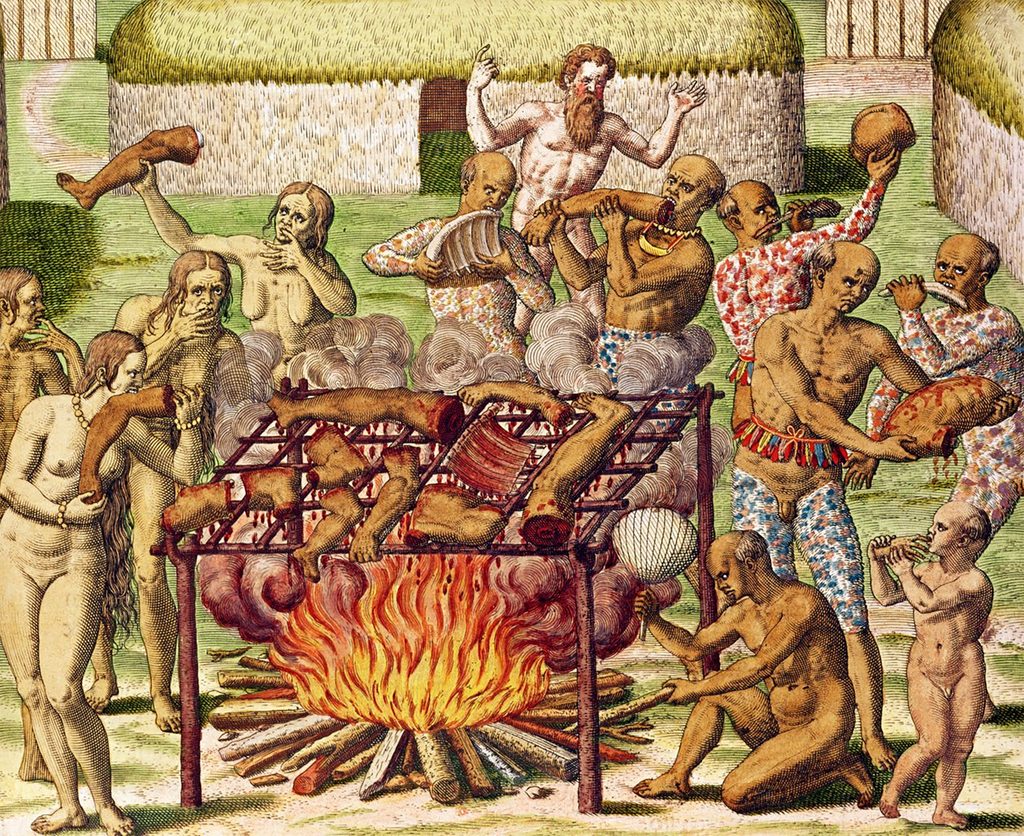
Editor's Note: Doreen wrote an essay titled In Search of the Cannibal Internet in April 2026 for Error 417 Expectation Failed, in which she explores in greater depth the ideas shared here about Caliban and his representation in relation to what Doreen calls a “cannibal Internet.” In that essay, Ríos uses Theodor de Bry’s image as a visual reference.
NKA: There’s a culture of intellectual property, well, of property in general, right? And of intellectual property specifically, which is kind of sacred in a way. Going against intellectual property is theft, right? You start thinking about jail; you end up in a cell. That doesn’t matter here, in other contexts, let’s say. I find the chatarrera community really interesting, you know, the one you spell with an “x.”
DR: Xatarrera, yes.
NKA: The Xatarrera community, which also, in a way, shares a kind of common vision, one that emerges precisely because it’s a community. A new collective imagination is also beginning to emerge, one that’s not only abstract but also material. Concrete, in a way. Of course, what’s happening in Mexico is also happening in many other parts of Latin America, with great intensity.
DR: Yes. I think that’s why those communities are so strong, precisely because they are communities.
NKA: Sure. They aren’t sudden inventions by a single person. [In the world of intellectual property] there’s also a bit of a tendency to glorify the individual who invented, isn’t there? It is true that there are many individuals who have done interesting things, but it doesn’t happen that often. In fact, I’m thinking about the anonymity of production within the xatarrera communities. So many of the reinvented objects that Oroza shows rarely have a name. Take this fan made from [vinyl] records, who made it? No one knows, but it reflects the Cuban community of technological disobedience. In a way, anonymity ends up being an expression of this community itself. That clashes a bit with the idea of art and the artist, authorship. And perhaps with how the art world, which, after all, in Latin America is no stranger to major institutions, expects the artist to take center stage, to claim authorship, to ensure ideas aren’t stolen, and so on. A kind of conflict begins to emerge that, when it comes to light, is, at best, interesting to observe. Perhaps it can lead to the development of new tactics…
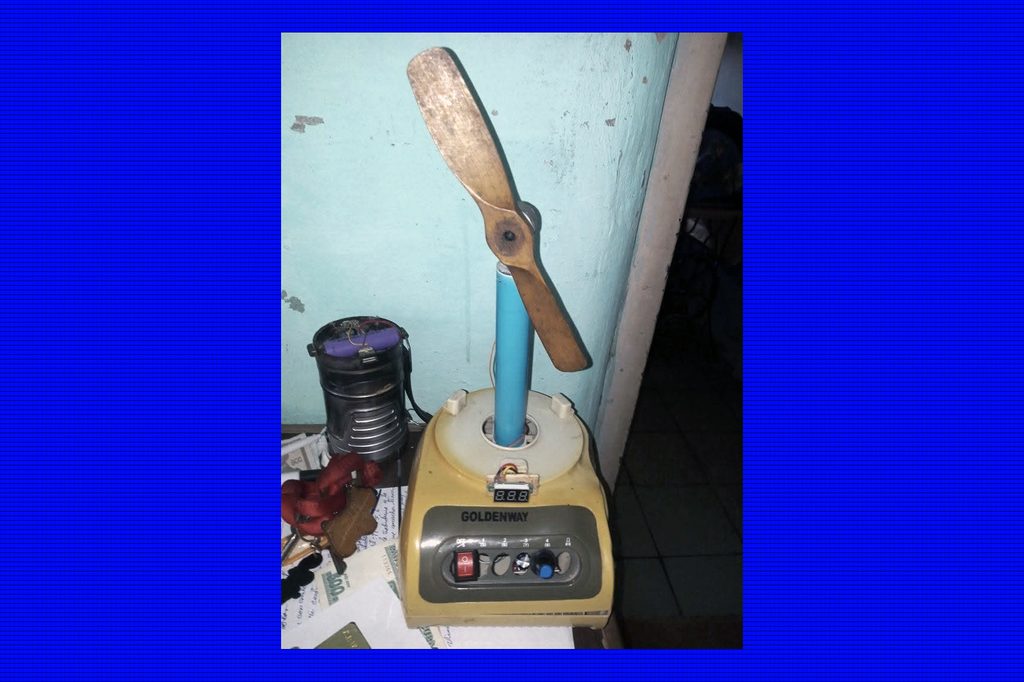
DR: Sure. I mean, there are a lot of very specific names of people who are active in this Xatarrera community. Again, maybe it’s cultural, but it’s not as if there isn’t such a thing as an author. There are very specific names within those communities: Arcángel Constantini, Iván Abreu, Marcela Armas, Gilberto Esparza, right? And the list goes on and on, but I think it has to do with processes. None of the people I just mentioned are the type to be secretive about their processes. Quite the opposite: they’re people who share their processes and are constantly leading workshops, giving presentations, or whatever else. It’s also connected to a kind of “outside-the-walls” pedagogy, where this exists. It’s not a competition where no one knows how I did it or how I solved it, but rather the opposite. Which, again, doesn’t undermine the figure of the artist, where, at the end of the day, specific pieces were made by specific people and they’re credited as such. But the processes are shared, aren’t they? It’s really beautiful; it’s even a bit romantic. But these are people who, when you ask them how they did something, or if someone else helped them in that process, they will tell you. And very often, those credit lists are incredibly long. That’s also what makes it so powerful. You know there’s a support system, and, at least from what I’ve seen, there’s also a sense of trust that what you want to do, you can do. There’s no fear of “I didn’t get it right the first time”; there’s a persistence of “if I don’t know how to do it myself, I can reach out to someone who might help me figure it out.” It’s a different process because it’s collaborative, even though in the end there are specific creators and specific artists. I don’t think there’s that level of competition that I see in the United States. For example, the master’s program here is a Master of Fine Arts, and everyone keeps their studio very private. It’s very “me and my process,” “if I let you in, it’s only when I decide.” I don’t see that kind of interaction where people step into each other’s spaces and work together. When I taught at the Universidad del Estado de México, also in the arts, it was the exact opposite. Everyone was constantly involved in each other’s creative processes. “Hey, how did you solve that? I haven’t been able to,” “Let me see, I’ll help you, and you help me with this.” Maybe not in the final piece, but certainly in the process.
If we look back at that form of anonymity, there is a very specific moment in Mexican contemporary art known as “The Generation of the Groups”6, which are precisely groups of people who do not act as individuals but as collectives. This was also a consequence of a very complex political moment, right after the massacre of students in 1968. The very act of engaging in political activism or political dissent puts you at serious risk; therefore, the concept of community and anonymity, achieved by working in a group where no one really knows who anyone else is, helps make these things possible. I mean, to give you an idea, it strikes me as an act of resilience: “We’re not going to stop, but we’re going to change our strategy.” There are figures and presences in the history of art and in the political history of Latin America that are deeply rooted in this, and which you have a hard time identifying here. Not because they don’t exist, of course they do, but simply because they aren’t as predominant.
NKA: That’s right. I was just thinking about what you said regarding the process. It ties in a bit with the idea of the technical object in constant evolution, which, based on your experiences, reinvents itself over and over again. Perhaps the process is endless. Perhaps the finished product, which is more like an idea coming from the North, is closely tied to the author’s vision, whereas the unfinished product, the eternal process, is more closely tied to the idea of the community. And that, in any case, makes it easier for the community to be constantly part of the process. Perhaps there are moments when that process is expressed, but then it returns to the workshop, the garage, or who knows where, and once again the community reinvents itself. I think it’s a really lovely image. I’m saying this right now because it came to me during this conversation, which I find beautiful! Doreen, time has flown by.
DR: I know!
NKA: I find everything you’ve just told me really interesting, and it also inspires me a lot. I hope we can keep talking in the future.
DR: Sure. See you next time!
This concludes this two-part conversation with Doreen Ríos. You can read the first part here. Many of the ideas in this interview are explored in greater detail in Medios Inestables. On Technical Objects and Art (A Coruña: Bartlebooth, 2025).
- The Afro-Peruvian cajón originated in colonial Peru among the enslaved African population, based on the wooden boxes used to transport goods, following the viceregal bans on the use of drums. It was declared a National Cultural Heritage in 2001. More information here. ↩︎
- This refers to community networks such as those run by Telecomunicaciones Indígenas Comunitarias A.C. (TIC), which since 2016 has been operating autonomous cell phone networks in Indigenous and rural communities—primarily in Oaxaca—in collaboration with the organization Rhizomatica. ↩︎
- Audre Lorde, “The Master’s Tools Will Never Dismantle the Master’s House” (1984), an essay included in Sister Outsider. ↩︎
- Ernesto Oroza describes “technological disobedience” based on the practices of repair, reinvention, and reappropriation that emerged in Cuba during the Special Period. See his website. ↩︎
- Notable among the anti-colonial reinterpretations of Caliban are *A Tempest* (1969) by Aimé Césaire and the essay *Caliban* (1971) by Roberto Fernández Retamar. ↩︎
- “The Generation of the Groups” refers to the art collectives that emerged in Mexico during the 1970s—such as Proceso Pentágono, No Grupo, Suma, and Germinal—in the aftermath of the 1968 Tlatelolco student massacre. ↩︎


Responses